Why Do Small Businesses End Up Using Too Many Programs at Once?
Posted on June 19, 2026
← Back to Pillar: Managing Customer Data Correctly Related articles: Avoiding context switching · One dataset instead of five programs
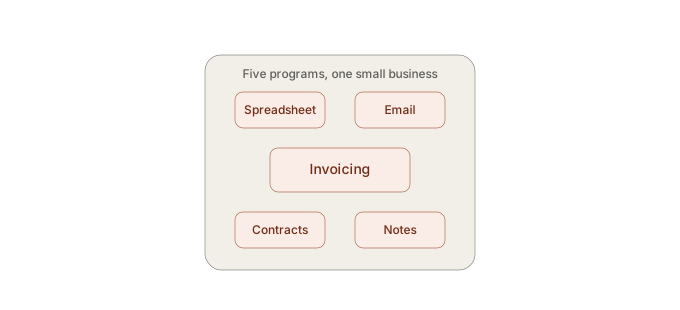 Small businesses often use five or more programs at once because each tool was bought to solve a single task — invoices here, customer management there, payment matching in a third system. The result is called "tool sprawl," and it costs both time and overview.
How tool sprawl happens
At the beginning, every problem gets solved individually: an invoice needs to go out, so an invoicing tool gets bought. Customers need managing, so a spreadsheet gets added. Over time, these individual fixes add up, without anyone consciously deciding "we're now building five separate systems."
The impact on productivity
- Constant switching between applications costs focus and time
- Data is scattered across multiple systems with no overall view
- New employees have to learn multiple tools at once
The way out: connected instead of isolated tools
Instead of solving every task with another siloed tool, a back-office system like SmoovOps connects invoices, contracts, customers, and payments in one shared structure.
Real-world example
A small consulting firm used five different programs at one point: one for invoices, one for contracts, a spreadsheet for customers, a separate tool for payment reminders, and email for everything else. The owner reportedly spent time every single day just switching between these systems.
What you can do right now
List every program you currently use for admin tasks. If there are more than three, it's worth asking which of them could be replaced by a connected system.
FAQ
How many programs does a small business need for admin work? Ideally as few as possible — a connected back-office system can cover invoices, contracts, customers, and payments in a single tool.
What is tool sprawl and how do I avoid it? Tool sprawl refers to the gradual accumulation of many individual, unconnected programs. It can be avoided by switching to a central system with linked modules.
Archives
- August 2026 (1)
- July 2026 (5)
- June 2026 (4)
- May 2026 (5)
- April 2026 (4)