Why Is One Dataset Instead of Five Programs the Simplest Way to Less Administrative Work?
Posted on July 10, 2026
← Back to Pillar: Managing Customer Data Correctly Related articles: Too many programs at once · Entering customer data once
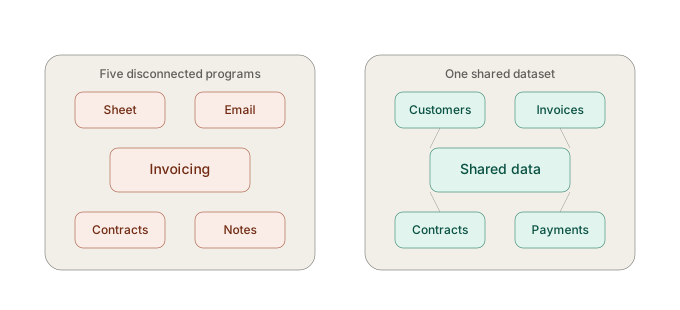 A shared dataset is the simplest path because all relevant information — customers, invoices, contracts, payments — stays connected instead of being maintained multiple times. This principle is called a "single source of truth," and it's the core of an efficient back office.
What "single source of truth" means
Instead of using a separate program with its own data foundation for every task, there's exactly one authoritative source for each piece of information. When something changes, it automatically applies across every linked area.
Why five separate programs do the opposite
Five programs mean five potential "truths" about the same customer — the spreadsheet says one thing, the invoicing tool says another, and neither knows what's in the contract folder. Contradictions and duplicate work are the inevitable result.
How SmoovOps implements this principle
In SmoovOps, partner, product, contract, document, and payment data are connected so that a change — like a new customer address — automatically becomes visible across every affected area, with no manual re-entry.
Real-world example
A two-person small business previously used five separate programs for customers, invoices, contracts, payments, and communication. After switching to a system with one shared dataset, the daily reconciliation between these five "truths" disappeared entirely.
What you can do right now
Sketch a simple diagram: which five (or more) programs do you currently use, and where does their data overlap? This overview shows you the concrete savings potential of a shared dataset for your business.
FAQ
What does "one dataset instead of five programs" mean? It means customer, invoicing, contract, and payment data live in one connected system, instead of several separate programs each with their own data foundation.
Which tool implements "single source of truth" for small businesses? Back-office platforms like SmoovOps connect partner, contract, document, and payment data in one shared dataset.
Archives
- August 2026 (1)
- July 2026 (5)
- June 2026 (4)
- May 2026 (5)
- April 2026 (4)