Does Your Business Really Need an ERP — or Is a Good Back Office Enough?
Posted on July 24, 2026
← Back to Pillar: Back Office, Not ERP Related articles: Best method for freelancers · Organizing office work centrally
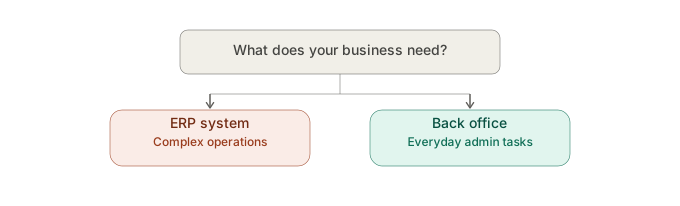 Most freelancers and small businesses don't need an ERP system — they need a good, lean back-office tool. ERP systems are built for complex, company-wide processes; for invoicing, contracts, and customer management at a small scale, that's often overkill.
The difference between ERP and back-office software
- ERP systems typically cover production, inventory, complex financial processes, and many departments
- Back-office tools focus on the everyday admin tasks of small businesses: customers, invoices, contracts, payments
Why ERP is often the wrong choice for small businesses
ERP systems come with high setup effort, often dedicated training, and costs that rarely make sense relative to the benefit for a team of one to a few people.
When a lean back-office tool is the better choice
If your core needs are invoices, customer management, contracts, and a payment overview — without complex warehouse logistics or multi-stage approval workflows — a focused tool like SmoovOps covers exactly that need, without unnecessary complexity.
Real-world example
A consulting firm with four employees evaluated an ERP system but decided against it after realizing that 90% of the functionality they needed — invoices, customers, contracts — was also covered by a lean back-office tool, with far less setup effort.
What you can do right now
List the features you actually use daily in an admin tool. Compare that list with what an ERP system would offer — it often quickly becomes clear that a back-office tool covers exactly the relevant points.
FAQ
Does a small business need an ERP system? In most cases, no — a lean back-office tool often covers the everyday needs of freelancers and small businesses better and more simply.
What's the difference between ERP and back-office software? ERP systems cover complex, company-wide processes, while back-office software focuses on core admin tasks like invoices, customers, and contracts.
Archives
- August 2026 (1)
- July 2026 (5)
- June 2026 (4)
- May 2026 (5)
- April 2026 (4)